Dog 狗
The Loyal Protector
The Dog Personality Map
Every Dog shares core traits, but the balance between them is what makes the sign unique. This personality map shows how the Dog's energy is distributed across eight dimensions, from thinking style and social energy to patience and emotional expression. Hover or tap any trait to see where the Dog falls on the full spectrum.
Dog Personality Map
Dogs are the most genuinely selfless sign in the zodiac. They will sacrifice their own comfort, advancement, and sometimes safety to protect someone they love or defend a principle they believe in. This is not a calculated martyrdom designed to earn gratitude. It is an instinct as natural as breathing. When a Dog sees injustice, they act. When a Dog sees someone in trouble, they help. The question of personal cost does not enter the equation until after the crisis is resolved.
The Dog's shadow is anxiety that masquerades as vigilance. They are so attuned to potential threats, dishonesty, and injustice that they can become chronically suspicious, pessimistic, and difficult to reassure. They worry about dangers that will never materialize, question motives that are perfectly innocent, and carry the weight of the world's problems as personal failures. The Dog's life lesson is learning that they cannot protect everyone from everything, and that sometimes the most courageous act is trusting that things will be okay.
Dog Lucky & Unlucky
Lucky
Unlucky
Dog Strengths & Weaknesses
Strengths
Weaknesses
Under Stress
Under stress, the Dog becomes hypervigilant, anxious, and combative about principles. They see threats everywhere, question everyone's motives, and become vocally critical of any behavior they perceive as dishonest or unfair. Their stress signal is moral outrage disproportionate to the trigger. When a Dog is ranting about a minor ethical violation at work, they are not upset about that specific issue. They are anxious about something larger and channeling it through their strongest instinct: the need to fight for what is right. The reset is physical companionship. A long walk with someone they trust, no conversation required, resets a Dog faster than any amount of reasoning.
In Social Settings
Dogs are selectively social. They are warm and engaging with people they know and trust, and cautious, observant, and slightly guarded with everyone else. They do not network. They connect. A Dog at a party will find the one genuine person in the room and spend the entire evening talking to them while ignoring the performative socializing happening everywhere else.
The Dog in Love
Romantic Style
Dogs love with a devotion that is almost old-fashioned in its sincerity. They are loyal, protective, and utterly committed once they decide someone is their person. They do not play games, keep backup options, or hedge their emotional bets. When a Dog is in, they are all the way in. The courtship is not flashy, but it is honest, and that honesty is more romantic than any grand gesture.
Emotional Needs
Dogs need to trust their partner completely. Not mostly. Not usually. Completely. One significant betrayal of trust can damage a Dog relationship permanently, not because Dogs are unforgiving, but because trust, once broken, never quite feels the same to them. They also need to feel that their partner shares their core values. A Dog can tolerate difference in almost every area except ethics.
Communication Style
Dogs communicate with earnest directness. They say what they mean, mean what they say, and are genuinely confused by people who don't. They are good at expressing concern, loyalty, and moral conviction. They are less good at expressing vulnerability, desire, and playfulness, which can make them feel serious even when they are trying to be light.
Relationship Challenges
The biggest challenge in loving a Dog is their anxiety. They worry about the relationship, about their partner's safety, about the future, about threats that exist only in their imagination. This worry is an expression of love, but it can feel like surveillance. Partners who need space may feel suffocated by a Dog's protective concern.
Ideal Partner Energy
The ideal partner for a Dog is someone warm, optimistic, and ethically grounded. Someone who shares the Dog's values but carries them with more lightness. The Tiger and Horse are classic matches because they share the Dog's courage and integrity while adding an energy and spontaneity that lifts the Dog out of their natural pessimism.
The Dog at Work
Work Style
Dogs are conscientious, reliable workers who do their best work when they believe in the mission. They cannot fake enthusiasm for a company they do not respect or a product they do not believe in. Put a Dog in a role that serves people, protects the vulnerable, or upholds standards of fairness, and they will give everything without being asked.
Leadership Style
Dog leaders lead through moral authority and personal example. They are fair, honest, and protective of their teams. They are the leader who takes the blame when things go wrong and shares the credit when things go right. Their weakness is that they can become paralyzed by ethical considerations that more pragmatic leaders would simply navigate around.
Natural Strengths
Social work, law enforcement, nursing, teaching, nonprofit management, veterinary medicine, and any role that combines service to others with ethical integrity. Dogs are also excellent in quality assurance and compliance because they genuinely care about standards.
Career Pitfalls
The Dog's career trap is burnout from caring too much. They take on the emotional weight of everyone around them, fight battles that are not theirs to fight, and never learn to separate professional responsibility from personal anguish. The Dog who does not build boundaries will eventually collapse from compassion fatigue.
Suitable Careers
Dog Compatibility
Full Compatibility Scores
Explore Any Pairing
Select any animal to see how they pair with the Dog.
Dog Body & Mind
Body Tendencies
Dogs tend toward chronic tension from their ever-present vigilance. Their nervous system runs hot, and they are prone to anxiety-related conditions including stomach ulcers, tension headaches, and insomnia. The digestive and nervous systems are their most vulnerable areas.
Stress Patterns
When stressed, Dogs develop insomnia, digestive problems, and restless legs. They pace, they worry out loud, and they cannot settle their body because their mind will not settle first. Their stress is always cognitive before it is physical: the worrying creates the symptoms, not the other way around.
Seasonal Sensitivity
Dogs are most energetically strong in autumn (their native season, specifically October) and can become anxious and restless during spring, when the world feels chaotic with new growth and unpredictable change. They prefer the stability of cooler seasons.
Wellness Advice
The most important health practice for a Dog is a daily anxiety-management routine. Not occasional meditation. A daily, non-negotiable practice that interrupts the worry cycle: walking, breathing exercises, journaling, or time with animals (real animals, not just their zodiac sign). Dogs also benefit enormously from having a dedicated 'worry time' where they allow themselves to worry for 15 minutes and then deliberately stop.
Diet & Nutrition
Dogs are stress eaters who reach for comfort food during anxious periods and lose appetite during crisis periods. Their digestive system is sensitive to their emotional state, making regular, calm mealtimes more important than perfect nutrition. Warm, simple food eaten at a consistent time in a peaceful environment is the Dog's ideal.
The Five Dogs
Your birth year determines your element. Each element reshapes the Dog's personality in distinct ways. Select yours to see the full profile.
Wood Dog
1934, 1994The Wood Dog is the warmest and most genuinely likeable version of the zodiac's most loyal sign. Wood takes the Dog's...
Fire Dog
1946, 2006The Fire Dog is the zodiac's crusader. Fire takes the Dog's already strong moral compass and sets it ablaze, creating...
Earth Dog
1958, 2018The Earth Dog is the most reliable and practically grounded version of the zodiac's most loyal sign. Earth takes the ...
Metal Dog
1910, 1970, 2030The Metal Dog is the most morally absolute and emotionally fortified version of the zodiac's most loyal sign. Metal t...
Water Dog
1922, 1982The Water Dog is the most emotionally intelligent and intuitively gifted version of the zodiac's most loyal sign. Wat...
Famous Dogs
Well-known figures born in the Year of the Dog.
The Dog in Chinese Culture
The Great Race
The Dog was an excellent swimmer and should have finished much earlier, but it had been so long since the Dog had a proper bath that it could not resist playing in the river. It arrived eleventh, happy and clean. Some versions say the Dog also stopped to help other animals struggling in the current before continuing. Both stories capture the Dog's nature: loyal service to others and a simple, joyful relationship with the physical world.
Cultural Significance
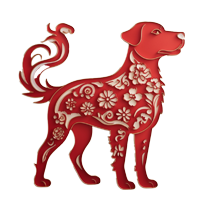
Dogs hold a special place in Chinese culture as symbols of loyalty, honesty, and protective guardianship. Stone dog statues guard the entrances to temples and homes, believed to ward off evil spirits. The expression 'a good dog does not block the road' (好狗不挡道) captures the Dog's nature: helpful, not obstructive. In Chinese folk belief, dogs can see spirits that humans cannot, making them spiritual protectors as well as physical ones.
The Shen Hour (7:00 PM - 9:00 PM (the Xu hour))
The Dog governs the Xu hour (7:00 PM to 9:00 PM), the early evening when families gather, doors are locked, and the home is secured for the night. This is a time of protection, togetherness, and settling in. Dog-born people often find that their strongest sense of purpose and calm comes in the early evening, when they can feel that the people they love are safe and accounted for.
Years of the Dog
Each year carries a different element. Click any year to explore that element variant.
Dog in the Year of the Fire Horse
"Your loyalty is the anchor others need this year."
The Dog and Horse share a trine bond, making this a naturally supportive year. The Horse's fire energy doesn't overwhelm you — it warms you. You feel more confident, more willing to take risks, and more open to change than usual. This is a year to step out of your comfort zone while your natural caution keeps you from going too far. People notice your reliability in a chaotic year, and it earns you trust, opportunities, and deeper connections.
This is one of your best years for relationships. Your warmth and loyalty shine brightest when the world feels uncertain. Existing relationships deepen through shared challenges. Single Dogs attract partners who value substance over flash — and those are the connections that last.
Steady financial progress is the Dog's path this year. No dramatic windfalls, but no dramatic losses either. Your honesty and reliability may lead to professional recognition — a raise, a promotion, or a new responsibility that comes with better compensation. Trust the process.
"My loyalty is my strength. In a year of fire, I am the steady ground others stand on."
Dog FAQ
What years are the Year of the Dog?
The Year of the Dog falls on a 12-year cycle. Recent and upcoming years include: 1946, 1958, 1970, 1982, 1994, 2006, 2018, 2030.
What personality traits define the Dog?
People born in the Year of the Dog are commonly described as loyal, honest, amiable. The Loyal Protector
Who is the Dog most compatible with?
The Dog is most compatible with the Tiger, Rabbit. Also compatible: Horse.
Who is the Dog least compatible with?
The Dog tends to have more challenging dynamics with the Dragon. These pairings require more conscious effort to thrive.
What element is the Dog in Chinese astrology?
The Dog's fixed element is Earth. However, each year also carries its own element (Wood, Fire, Earth, Metal, or Water), creating variations like the Earth Dog or the Water Dog.
What are the lucky and unlucky colors for the Dog?
The Dog's lucky colors are red, green, and purple. Unlucky colors include blue and white. Red especially resonates with the Dog's protective, warm nature.
What is the Dog's lucky time of day?
The Dog governs the Xu hour (7:00 PM to 9:00 PM), the early evening when families gather and homes are secured. Dogs often feel their strongest sense of calm and purpose during this period.
What careers are best for people born in the Year of the Dog?
Dogs excel in social work, law enforcement, nursing, teaching, nonprofit leadership, veterinary medicine, and any role combining service to others with ethical integrity. They thrive when their work has moral purpose.
Why did the Dog finish eleventh in the Great Race?
Despite being an excellent swimmer, the Dog could not resist playing in the river and some versions say it stopped to help struggling animals. This reflects the Dog's nature: joyful, service-oriented, and unconcerned with winning.
What health issues should Dogs watch out for?
Dogs are most vulnerable to anxiety-related conditions: insomnia, digestive problems, tension headaches, and restless legs. A daily anxiety-management routine (walking, breathing exercises, time with animals) is more important than any other health practice.
The Dog in Relationships
Friendship Style
Dogs are the most loyal friends in the zodiac. They show up at 3 AM without being asked, defend you in rooms you are not in, and remember the hard things you told them years ago. They do not have many friends, but every friendship they have is tested and permanent. A Dog friendship is the closest thing the zodiac has to family by choice.
Loyalty Pattern
Dog loyalty is absolute and unconditional within their inner circle. They will defend a friend even when it costs them personally. However, Dogs hold strong opinions about character, and if a friend consistently demonstrates values the Dog finds reprehensible, the Dog will not betray the friend. They will grieve the friendship and quietly withdraw.
Family Dynamic
Dogs are devoted, protective parents who create safe, stable family environments. They worry constantly about their children's welfare, teach strong values by example, and sacrifice personal desires for family needs without resentment. They can be overprotective, and their anxiety can sometimes transfer to their children as a learned behavior.
Conflict Style
Dogs fight for principle, not for ego. They do not pick fights, but they do not back down from them when justice is at stake. Dog conflict is characterized by moral conviction: they argue from a place of genuine belief that they are right, which makes them difficult to negotiate with. The most effective way to resolve conflict with a Dog is to appeal to their sense of fairness rather than trying to win on logic alone.